
Table of Contents
- The Enduring Mystery of Celtic Knotwork
- Types of Celtic Knots and Their Meanings
- The Endless Loop: Interconnection and Eternity
- Celtic Knot Jewelry Symbolism: Wearing Your Story
- How to Identify Authentic Celtic Symbols
- Regional Variations and the Geometry of Knotwork
- Modern Appreciation vs. Cultural Appropriation
- Frequently Asked Questions
Last Updated: September 29, 2026
The Enduring Mystery of Celtic Knotwork
The meaning of celtic knotwork symbols rests on a single idea: an unbroken line that never begins and never ends. These interlacing patterns, carved into stone crosses and illuminated in medieval manuscripts, represent eternity, interconnection, and the cyclical nature of existence. At Enchanted Jewelry & Gifts, we offer these designs for those who seek a symbol that carries weight, not just decoration.
Celtic knotwork is a style of decorative art built from continuous, interlaced lines that form intricate geometric patterns. The tradition stretches back well over a thousand years, appearing in insular art across Ireland, Scotland, and Wales. Most surviving examples come from stone monuments and manuscript illumination, which is why the historical record is rich in form but thin on written explanation.
Here's the part most guides get wrong: the Celts left almost no written record of what these knots meant to them. Much of what we call "meaning" today comes from later Christian interpretation and modern revival, not from ancient documentation. That doesn't make the symbolism less real. It makes it more interesting.
Below, we'll walk through the major knot types, their symbolism, and how to tell authentic craftsmanship from a printed imitation.
Types of Celtic Knots and Their Meanings
Each knot carries its own emphasis, but all of them share the same foundation: lines that weave without breaking. The three most recognizable are the Triquetra, the Dara Knot, and the Celtic cross.
The Triquetra (Trinity Knot)
The Triquetra is a three-pointed knot formed from one continuous line, and it is the most widely recognized of all Celtic motifs. Its three interlocking arcs are most commonly read as the Holy Trinity: Father, Son, and Holy Spirit. Older and broader readings include the three domains of earth, sea, and sky, or the cycle of birth, life, and death.
What most people miss is that the Triquetra predates Christian use. It appears on early Germanic coins before it shows up in Christian contexts, which suggests the symbol was adopted and reinterpreted rather than invented by the church. That layered history is exactly why it still resonates.
The Dara Knot
The Dara Knot takes its name from doire, the Irish word for oak, and it represents the root system of a great oak tree. Where the Triquetra is about the divine, the Dara Knot is about inner strength, wisdom, and the quiet power of deep roots.
A common mistake is treating the Dara Knot as a single fixed design. In practice, it exists in many variations, and modern jewelers interpret the root structure differently from one another.
The Celtic Cross
The Celtic cross is a Latin cross with a ring around the intersection of the vertical and horizontal arms. The ring is generally understood as a solar symbol or a sign of eternity, merged with the Christian cross to bridge older and newer traditions.
The four arms are sometimes linked to the four directions or the four elements. This is a case where the spiritual and the geometric overlap neatly, and it's part of why the design survived so well.
The Endless Loop: Interconnection and Eternity
The endless loop is the engine behind every knot on this list. Because the line has no start and no end, it stands for continuity, unity, and the interconnection of all things. In Celtic thought, that idea shows up everywhere: in the cyclical nature of the seasons, in kinship ties, and in the belief that the spiritual and physical worlds touch.
What most guides skip is where that reading actually comes from. The Celts themselves left almost no written theology, so the "endless loop" interpretation is largely a reconstruction. The clearest evidence comes from the objects themselves. The Book of Kells, an illuminated Gospel manuscript produced around 800 CE and held at Trinity College Dublin, packs its pages with interlace so dense that a single decorative panel can contain hundreds of crossings. The Chi Rho page alone is a labyrinth of spirals, animals, and human figures woven into one continuous field. That density is the point: the medieval monks who made it were not decorating a margin, they were making a theological argument in line.
The same logic shows up in stone. The high crosses of Ireland and Scotland, Muiredach's Cross at Monasterboice, the Ruthwell Cross in Dumfries and Galloway, wrap their shafts and rings in interlace that reads as a single unbroken ribbon. On a carved cross, that ribbon visually ties the base to the head, the earth to the divine, in one motion the eye can follow.
Here is the mechanism worth understanding: in a properly constructed knot, every line that enters the pattern must exit it, and every crossing alternates over-under. That rule is what makes the loop "endless" in a literal, structural sense rather than a poetic one. If you trace a true knot with your finger, you will return to your starting point without ever lifting off. A decorative imitation breaks that rule, lines dead-end, or the over-under sequence stutters, and the illusion collapses.
That structural fact is also why the same shape can carry so many readings.
Celtic Knot Jewelry Symbolism: Wearing Your Story
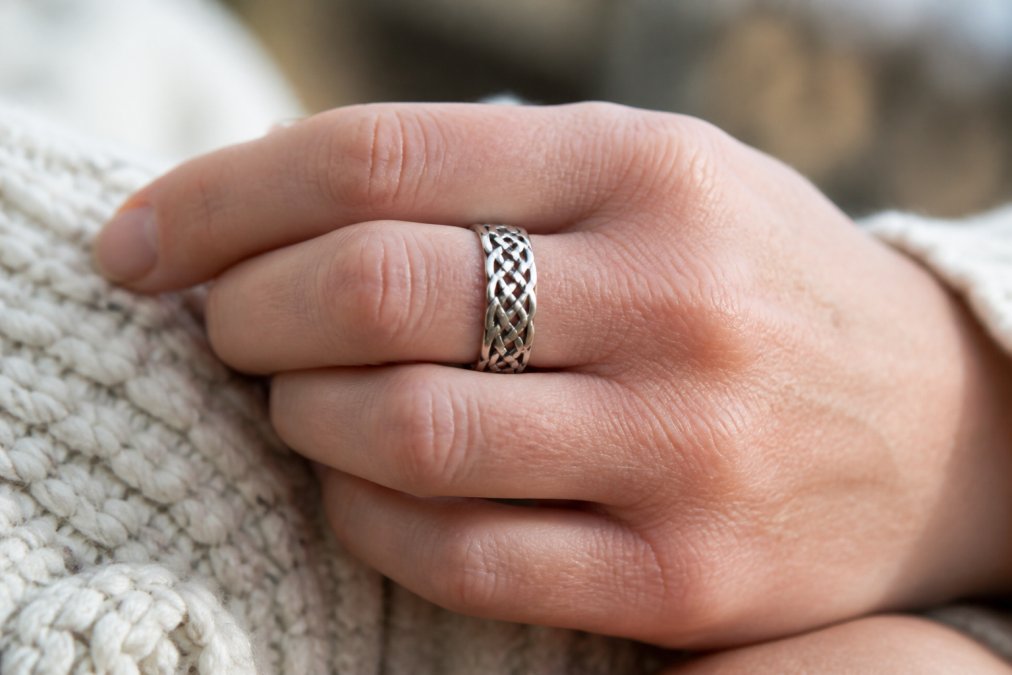
Celtic knot jewelry symbolism turns a historical pattern into something personal. A knot worn as a ring, pendant, or bracelet becomes a statement about what the wearer values: faith, courage, kinship, or continuity. The symbolism travels with the piece.
Then look at how the metal was made.
| Knot | Core Meaning | Best For |
|---|---|---|
| Triquetra | Trinity, threefold cycles | Faith-based gifts, everyday wear |
| Dara Knot | Strength, wisdom, deep roots | Milestone gifts, personal resolve |
| Celtic Cross | Faith merged with eternity | Heritage pieces, memorials |
| Quaternary Knot | Four directions, four elements | Balance and grounding gifts |
| Endless loop | Interconnection, continuity | Friendship and kinship tokens |
How to Identify Authentic Celtic Symbols
Authenticity comes down to two things: correct construction and honest sourcing. A genuine knotwork design follows the rules of interlacing, meaning the lines pass over and under in a consistent, traceable pattern. If the lines simply cross without weaving, it's a decorative imitation, not knotwork.
Use this quick checklist before you buy:
- Trace one line with your eye: does it continue without breaking or dead-ending?
- Check the over-under sequence: is it consistent, or does it break randomly?
- Look for depth and finishing: hand-finished edges catch light differently from stamped ones
- Ask the maker what knot it is and where the design comes from
- Be wary of "Celtic" labels on shapes that aren't interlaced at all
Regional Variations and the Geometry of Knotwork
Knotwork wasn't uniform across the Celtic world, and that's one of the most overlooked parts of the story. Regional traditions developed their own density, spacing, and preferred motifs. Pictish carvings tend toward tighter, more animal-inclusive patterns, while manuscript illumination leans into precise, symmetrical interlacing.
Modern Appreciation vs. Cultural Appropriation
There's a real line between appreciating Celtic heritage and treating it as a costume. Wearing a knot because you connect with its meaning, or because it honors your ancestry, is appreciation. Slapping a Triquetra on a product with no understanding of its history, or claiming a design belongs to a culture it doesn't, crosses into appropriation.
Frequently Asked Questions
Is Celtic knotwork pagan?
Celtic knotwork predates Christianity in Ireland and Britain, so its roots are pagan. However, when monks began transcribing manuscripts like the Book of Kells around 800 AD, they adopted the interlacing patterns into Christian art. The knots became a symbol of the Holy Trinity and eternal life. Today, people of many faiths and spiritual paths wear Celtic knots, appreciating both their ancient origins and their later religious adaptations.
Is it okay to wear a Celtic knot?
Yes, wearing a Celtic knot is generally considered respectful if you appreciate its cultural and historical significance. The knotwork represents interconnection, eternity, and heritage. If you have Celtic ancestry, it can be a meaningful connection to your roots. If you don't, wearing one as a symbol of universal themes like love or continuity is still valid. Choosing well-made pieces from brands that honor the craft, such as Enchanted Jewelry & Gifts, can show appreciation rather than appropriation.
What do the continuous lines in Celtic knots represent?
The unbroken lines in Celtic knotwork symbolize eternity, the endless cycle of life, death, and rebirth, and the interconnectedness of all things. Because the line has no beginning or end, it represents infinity and the idea that spiritual energy flows continuously. In jewelry, this makes Celtic knots popular for wedding bands, friendship bracelets, and memorial pieces, as the design carries a message of lasting bonds and continuity beyond physical presence.
How can I tell if a Celtic knot design is authentic?
Look for true interlacing where lines pass over and under each other in a consistent pattern. Authentic designs usually have a clear geometric structure, often based on a grid or circle. Check for historical motifs like the Triquetra, Dara Knot, or Celtic Cross rather than generic swirls. Reputable sellers, such as Enchanted Jewelry & Gifts, provide details about the symbolism and craftsmanship, which can help you make informed choices.
Are Celtic knots and witch's knots the same?
No, they are different. A witch's knot is a specific symbol of a circle with a cross through it, used in some modern witchcraft traditions for protection. Celtic knots are a broader family of interlaced designs from Celtic art, including the Triquetra, Dara Knot, and endless loops. While both can be used in spiritual practices, Celtic knotwork has a distinct history rooted in Insular art and Celtic heritage, whereas the witch's knot is more associated with contemporary esoteric symbolism.
Celtic knotwork rewards anyone willing to look past the surface. The challenge is finding pieces that honor the tradition instead of flattening it into decoration. Enchanted Jewelry & Gifts carries a curated range of Celtic jewelry, amulets, and talismans made for people who care about craftsmanship and meaning, alongside our wider collection of gothic and spiritual accessories. Explore the collection and find a knot that tells your story.